Research

From micromolar to picomolar.

We turn weak screening hits into drug-strength molecules. Free-energy calculations predict which molecule to make next; we then synthesize, assay and crystallize it — closing the loop until an inhibitor binds its target orders of magnitude more tightly than where we began.

Why it matters

Two campaigns.

The group's two largest campaigns took on the defining virus of two different decades — and each ended with molecules more potent than medicines already on the market.

How it works

How a campaign runs

Synthesis is the slow, expensive step. Free-energy perturbation simulates each candidate inside the target's binding site and ranks them by how tightly they should bind, before they are synthesized.

  1. 1

    Design

    Model the inhibitor inside the target's binding site — docking a hit, or growing new groups in place with BOMB — and propose the next analogs.

  2. 2

    Predict · FEP

    Free-energy perturbation computes each analog's change in binding free energy (ΔΔG) by Monte Carlo simulation in BOSS / MCPRO — ranking them before one is made.

  3. 3

    Make

    Synthesize the highest-ranked compound in our own laboratory.

  4. 4

    Test

    Measure potency and solve the X-ray crystal structure with collaborators — confirming the prediction and guiding the next design round.

Each structure sharpens the next round — repeated until a micromolar hit becomes a low nanomolar lead.

The toolkit

The software behind

Every step above runs on code written in this group: BOSS and MCPRO for the Monte Carlo and free-energy perturbation, the OPLS force fields for the energetics, BOMB for growing analogs inside a binding site, and LigParGen for the parameters. see more here →

The signature result

The HIV‑1 campaign, compound by compound

Here is that HIV‑1 campaign as it actually ran — seven synthesized compounds, each one the molecule the free‑energy calculation ranked highest at that point. Every rung is a real, assayed compound, and the picomolar lead's binding was later confirmed by X‑ray crystallography.

Anti-HIV-1 potency across seven synthesized compounds from the 2011 campaign, on a logarithmic scale — from compound 1 at 4.87 micromolar down to compound 42 at 55 picomolar, roughly a ninety-thousand-fold gain.

Hover, tap or tab to any point to see the edit that produced it.

Each edit was chosen by predicting its effect on binding free energy before a single gram was synthesized. Anti‑HIV‑1 EC₅₀ values against wild‑type virus in infected MT‑2 cells, from Tables 2 and 4 of Bollini, Domaoal, Thakur, Gallardo‑Macias, Spasov, Anderson & Jorgensen, J. Med. Chem. 2011, 54, 8582 (doi:10.1021/jm201134m); the campaign made many more compounds than the seven milestones plotted here. The series was later extended to inhibitors that stay picomolar against drug‑resistant HIV (Lee et al., J. Am. Chem. Soc. 2013, 135, 16705) and advanced to a long‑acting preclinical candidate (Chan et al., PNAS 2018, 10.1073/pnas.1717932115).
The COVID-19 campaign

In response to COVID, from a weak hit to a preclinical candidate

The HIV campaign took years. When SARS‑CoV‑2 arrived, the same loop ran on a different clock: an approved epilepsy drug that barely bound the viral protease was reshaped into a nanomolar inhibitor in a matter of weeks, with crystallography confirming the predictions almost as fast as they were made.

  1. 2020 · spring

    A virtual screen of known drugs against Mpro gives 42 consensus hits; 17 are bought and assayed, and 14 are active — the pool the optimization starts from.

  2. 2020 · June

    Perampanel — an approved epilepsy drug and a very weak hit at 100–250 µM — is picked for optimization. The first FEP-guided designs come back at 10, 6.4 and 4.0 µM.

  3. 2020 · 2 September

    The ninth compound made reaches an IC50 of 140 nM. That is roughly a thousand-fold gain in a few weeks of design.

  4. 2020 · 4 October

    A 1.6 Å crystal structure confirms the predicted binding mode exactly.

  5. 2021 · February

    Published: 27 compounds, five crystal structures, IC50 values around 20 nM — from weak hit to potent lead in a few months.

  6. 2021 · July

    Triarylpyridinones reach EC50 ≈ 80 nM against infectious virus.

  7. 2024 · April

    Mpro61 is profiled as a preclinical candidate: no CYP3A4 inhibition, so no ritonavir booster is needed, and it acts synergistically with molnupiravir.

Beyond the antivirals

Other targets

Immunology · Inflammation

Macrophage Migration Inhibitory Factor

screening hit low nM

MIF is a cytokine implicated in inflammation, autoimmune disease, and cancer. Virtual screening and FEP-guided optimization delivered low-nanomolar inhibitors of its tautomerase activity, against human MIF and the malaria-parasite ortholog.

Also in progress

Further targets

  • hDM2 and hDMX
  • Tdp1
  • FGFR1 kinase
  • JAK2 kinase
  • DNMT

Campaigns at earlier stages, run through the same design–make–test loop — spanning oncology, inflammation and epigenetics.
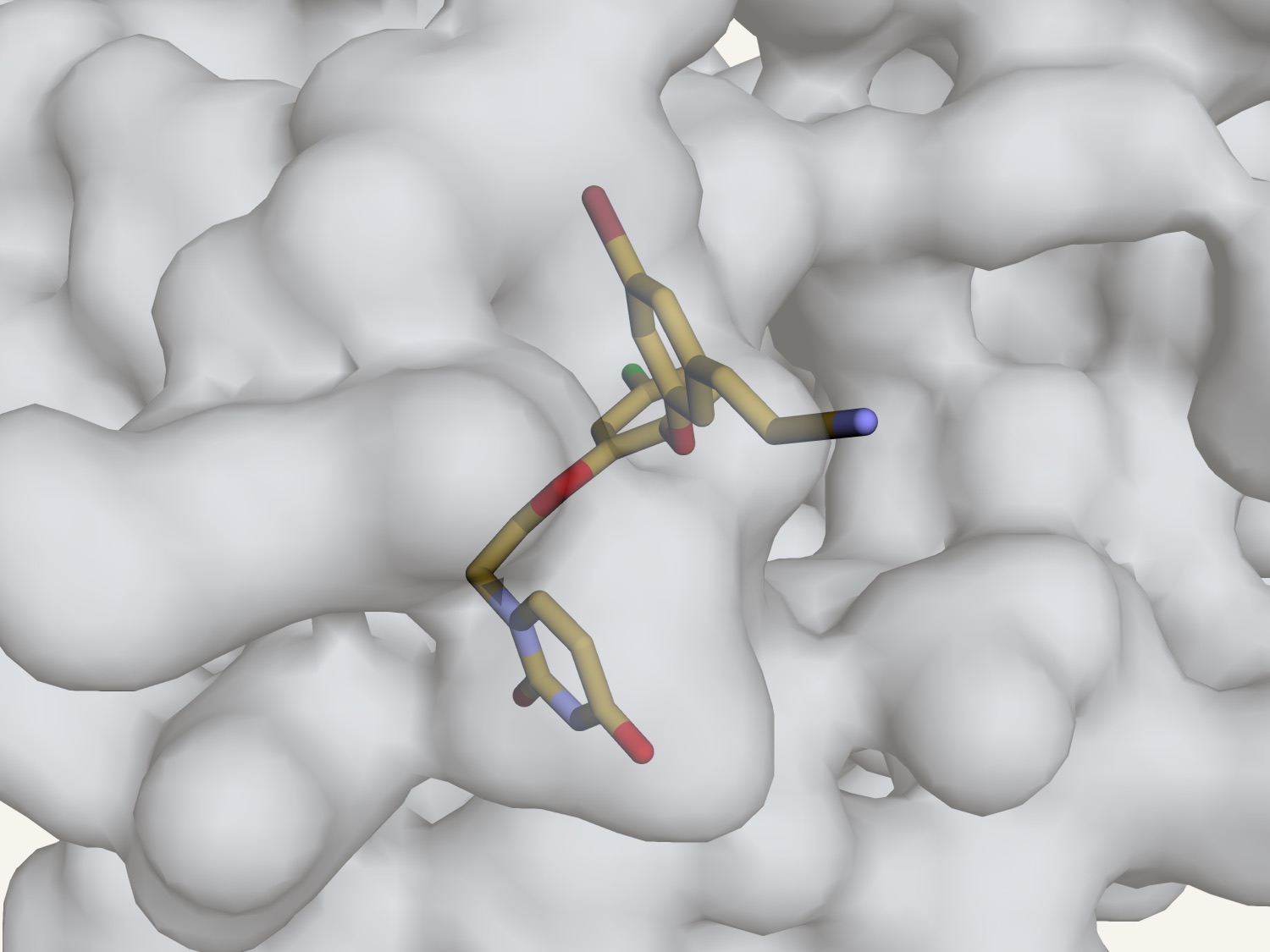
A catechol diether inhibitor, shown as gold sticks, bound in the non-nucleoside inhibitor pocket of HIV-1 reverse transcriptase, whose molecular surface encloses it.
HIV‑1 reverse transcriptase. A catechol diether of the compound 42 series in the non‑nucleoside pocket. PDB 4LSN · Frey et al., Chem. Biol. Drug Des. 2014, 83, 541.
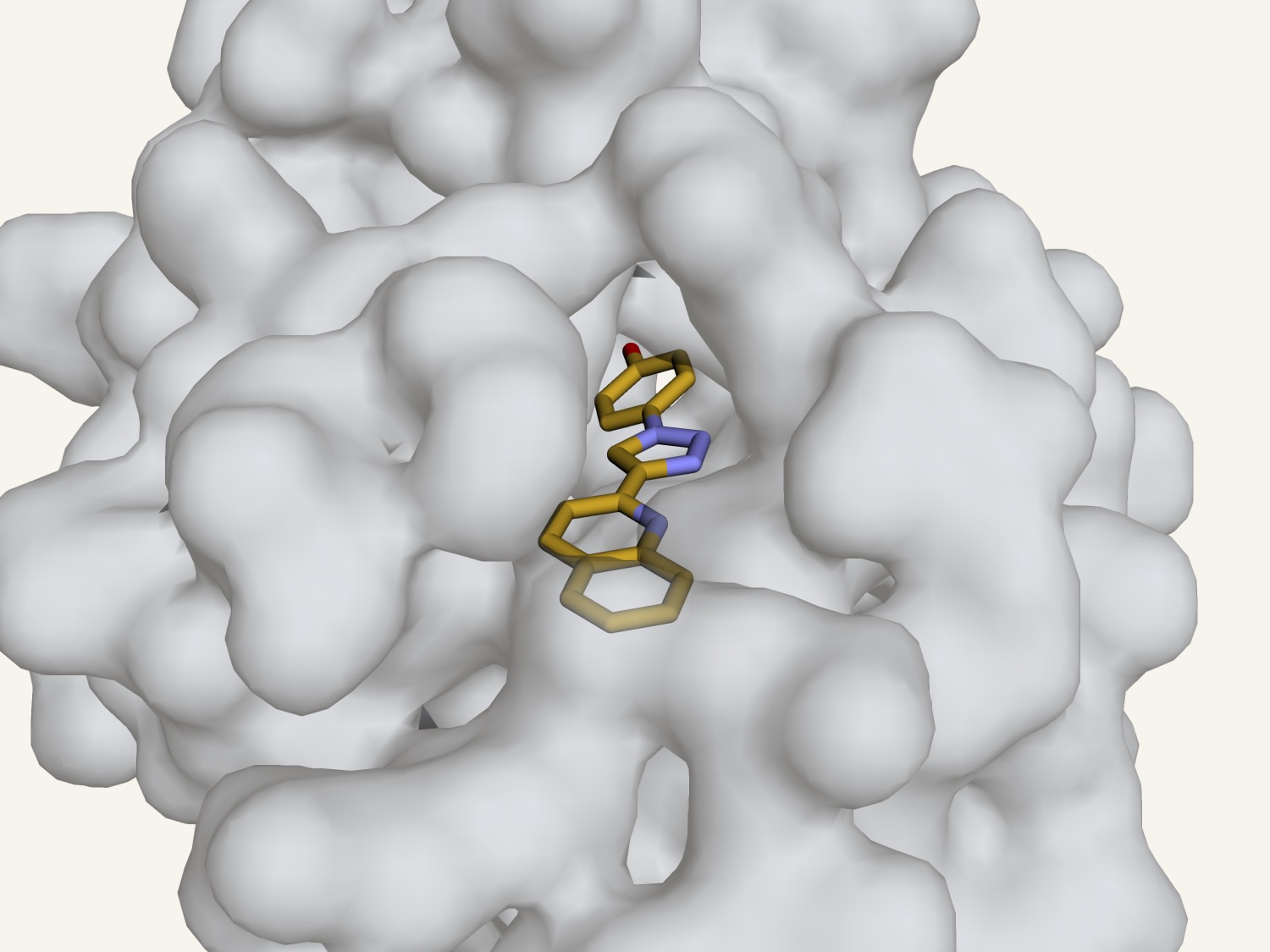
A biaryltriazole inhibitor, shown as gold sticks, bound in the tautomerase active site of macrophage migration inhibitory factor, whose molecular surface encloses it.
MIF. A biaryltriazole in the tautomerase active site. PDB 4WR8 · Dziedzic et al., J. Am. Chem. Soc. 2015, 137, 2996.
Designed inhibitors in their targets, rendered from the group's own deposited crystal structures — the experimental confirmation that closes each design cycle.
Right now

Current work

Current work pushes the SARS‑CoV‑2 main-protease candidate Mpro61 against emerging resistance and into combination regimens; examines a dual-function Gag‑Pol dimerizer that recruits the CARD8 inflammasome to clear HIV-infected cells; and continues the methodological work every campaign rests on — new OPLS parameters, and Monte Carlo free energies of hydration and solvation.

The programme

Four goals, fifty years.

  1. I

    Characterize intermolecular interactions in solution

    How molecules actually behave in a solvent, rather than in a vacuum. This is where the OPLS force fields and the TIP3P/TIP4P water models came from — the potentials that made everything after it quantitative.

  2. II

    Model solvent effects on reaction rates

    Reaction mechanisms, medium effects, and the influence of site-specific mutations on enzymatic reactions — treated with QM/MM: the reacting atoms quantum-mechanically, the surrounding solvent by molecular mechanics, all sampled by Monte Carlo.

    QM/MM · PDDG/PM3
  3. III

    Prove free-energy calculations can optimize a drug lead

    First retrospectively, against series whose activities were already known; then prospectively, choosing which molecule to make next. That test is what the HIV and SARS‑CoV‑2 campaigns above are.

    MCPRO · BOMB · two preclinical candidates
  4. IV

    Perfect pure-liquid and solution properties

    The accuracy ceiling on every prediction above is the force field, so the force field keeps being rebuilt. Recent work reaches 0.2 kcal/mol on heats of vaporization and 0.01 g·cm−3 on densities — and resolves the long-standing problem of excess hydrocarbon hydrophobicity.

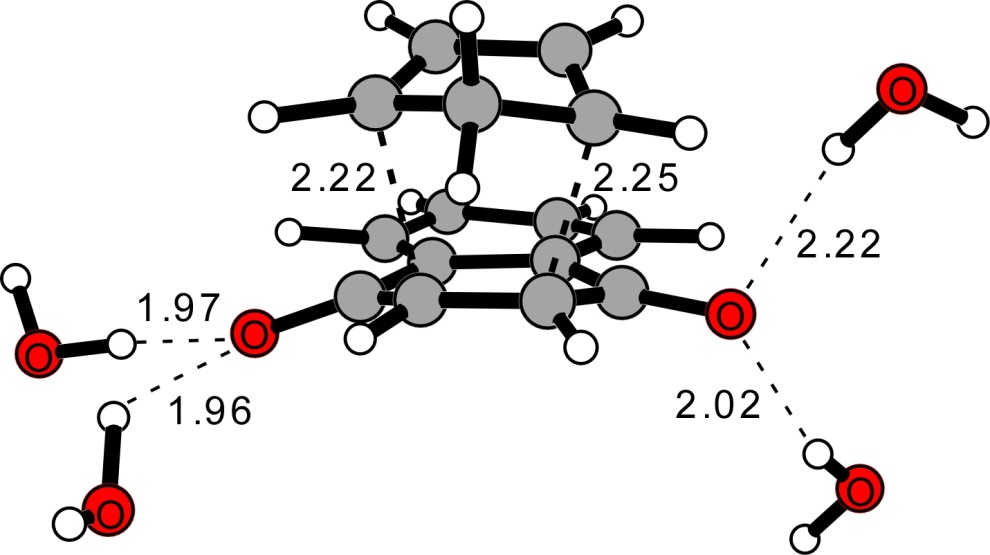
The transition state for the Diels-Alder reaction of naphthoquinone with cyclopentadiene in water, with forming carbon-carbon bonds of 2.22 and 2.25 angstroms and hydrogen bonds to four surrounding water molecules.
Goal II, made concrete: the transition state for a Diels–Alder reaction between naphthoquinone and cyclopentadiene in water, from QM/MM Monte Carlo. Dashes mark the forming carbon–carbon bonds (2.22 and 2.25 Å) and the hydrogen bonds to individual water molecules that stabilize the transition state and accelerate the reaction. A single two-dimensional free-energy surface of this kind costs on the order of 100 million quantum calculations. Acevedo, O.; Jorgensen, W. L. J. Chem. Theory Comput. 2007, 3, 1412. Original QM+MM treatment: Blake, J. F.; Jorgensen, W. L. J. Am. Chem. Soc. 1991, 113, 7430.
Selected Reviews

Reviews and perspectives.

Jorgensen, W. L. · Acc. Chem. Res. 1989, 22, 184–189.
Jorgensen, W. L. · Science 2004, 303, 1813–1818.
Jorgensen, W. L.; Tirado-Rives, J. · Proc. Natl. Acad. Sci. USA 2005, 102, 6665–6670.
Jorgensen, W. L.; Thomas, L. L. · J. Chem. Theory Comput. 2008, 4, 869–876.
Jorgensen, W. L. · Acc. Chem. Res. 2009, 42, 724–733.
Acevedo, O.; Jorgensen, W. L. · Acc. Chem. Res. 2010, 43, 142–151.
Jorgensen, W. L. · J. Chem. Phys. 2024, 161, 064111.
All publications
Research Funding

With gratitude for the support of:

National Institutes of Health — General Medical Sciences National Institutes of Health — Allergy & Infectious Diseases National Science Foundation Defense Advanced Research Projects Agency National Foundation for Cancer Research Alliance for Lupus Research